
Understanding the Episcopal Transition
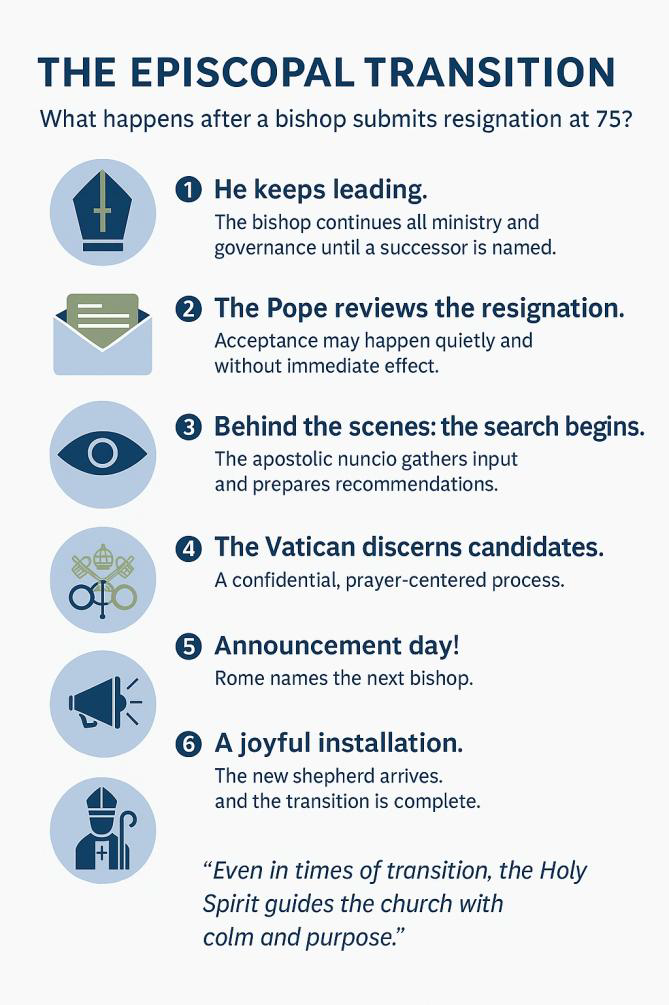 The episcopal transition is both a canonical process and a sacred moment in the life of the Church. It reflects the continuity of apostolic leadership – ensuring that the mission entrusted to the apostles continues through each generation.
This period is marked not only by administrative steps, but by prayer, liturgy and visible signs of unity, reminding us that Christ remains the true shepherd of his Church.
From Rome to Erie: The Appointment
The appointment of a bishop is made by the Holy Father and announced by the Holy See.
At the appropriate time, the Apostolic Letter of Appointment – also known as the Papal Mandate – will be formally received and proclaimed, marking the official beginning of the next chapter for the Diocese of Erie.
Announcement Day and What Follows
1. The Announcement
At the appointed time—typically 12 p.m. in Rome (6 a.m. ET)—the Vatican announces the new bishop. The Diocese of Erie shares the news at the same moment.
2. Welcome and Introduction
Later that day, the bishop-designate usually arrives at St. Mark Catholic Center for a press conference, where he is introduced and greets the people of the diocese.
3. If He Is Not Yet a Bishop
If the appointee is still a priest, plans are made for his ordination as a bishop. If he is already a bishop, an Installation Mass is planned. Details of this special Mass are shared at the press conference.
4. Preparing for Ordination/Installation
Planning begins for the installation Mass, when he will officially become the bishop of the diocese. This typically takes place about two to three months after the announcement.
5. Looking Ahead
In the days following the announcement, the bishop-designate begins preparing to move and to take up his new responsibilities.
Key Moments in the Transition
Solemn Vespers
Celebrated on the eve of the installation, this liturgy gathers clergy and faithful in prayer, asking the Holy Spirit to guide the bishop-elect and the local Church.
Episcopal Ordination or Installation
If the bishop-elect is not already a bishop, he is ordained during a solemn Mass. Within this sacred liturgy:
• The Apostolic Letter (Papal Mandate) is proclaimed
• Promises of fidelity are made
• The Litany of the Saints is invoked
• The laying on of hands takes place
• The Book of the Gospels is placed upon his head
• He is anointed with Sacred Chrism
The Rite of Installation follows, when the new bishop is seated in the cathedra of the cathedral—signifying his role as teacher, shepherd and high priest of the diocese.
Diocesan Celebration
Moments of welcome continue through receptions, parish visits and gatherings, allowing the faithful to encounter their new bishop.
Episcopal Transition: What does it mean for a diocese?
An episcopal transition is a time of faith, hope, and preparation for a diocese. Read more in Faith magazine to learn how this process supports the life and mission of the Church.