

What inspires a Sunday homily?
by Kristine Rilling
09/04/2026
Each weekend, Catholics gather to hear the Gospel proclaimed. While the Scriptures may be familiar, homilies invite us to encounter Christ in our daily lives.
Before a priest or deacon stands before the faithful, there is often a quieter journey of prayer, study, reflection and listening.
Pope Leo XIV has emphasized the personal nature of preaching, cautioning clergy against relying on artificial intelligence to prepare homilies. Authentic preaching, he reminded them, flows from faith, prayer and lived experience.
“To give a true homily is to share faith,” the Holy Father said, noting that AI cannot replace the personal witness of a believer. He has encouraged priests to listen to the Lord in prayer, allowing the Gospel to take root in their hearts before sharing it with others.
Clergy across the Diocese of Erie offer a glimpse into their own preparation, revealing that effective preaching is more than crafting a message. It is an act of prayer and a labor of love, helping God’s people recognize Christ speaking to them today.
PLANTING THE SEED
For many clergy, preparation begins early in the week, sometimes immediately after Sunday Mass. The coming Scriptures plant a seed nourished by prayer, study, daily experiences and the Holy Spirit.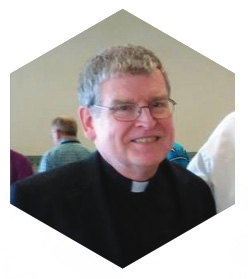 “On Sunday, after Masses, I normally take a walk outside and read over and jot notes on the Scriptures for the following Sunday. I don’t stop until I have a possible ‘thought’ about what to preach. Often, I pull out a Bible and sometimes a commentary in these initial stages. Normally on Monday, I repeat the process. If a thought or inspiration pops into my head, I pull out my notes and jot that down. By Friday afternoon or Saturday morning, I am finalizing my thought process and organization, but sometimes it takes until Saturday afternoon. Usually the next-to-last step is to decide on a story or illustration with which to open. The last step is to hand write my notes on a small piece of paper.”
— Father John Jacquel
SCRIPTURE IN ONE HAND, DAILY LIFE IN THE OTHER
Across the responses, one conviction was clear: the homily begins with the Word of God. Scripture provides the foundation and direction, while study helps preachers understand its original context and find language that speaks to the faithful today. 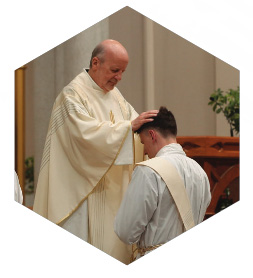 On a normal Sunday afternoon, I look at the Scripture readings for the coming Sunday. I simply read them and ‘plant the seed.’ On Monday and Tuesday, I will read some biblical commentaries and stay aware of what’s happening in the news around the world. I try to find a good lead-in to my homily, whether a story or a life event (recent or from the past). By Wednesday, I begin to write out my thoughts and ideas. I do not write out my homily, but I have some notes that keep me focused. On Thursday, it is generally completed.”
— Monsignor Richard Siefer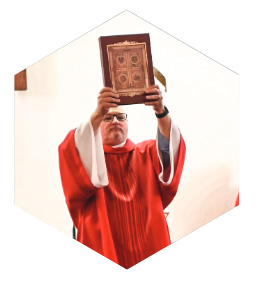 “My habit is to always preach from one of the Sunday readings; for me, that is nonnegotiable. The Scriptures proclaimed at Mass are the foundation of the homily, and I believe the preacher's task is to help the faithful hear and apply God's Word to their daily lives.”
— Deacon Frank Hannah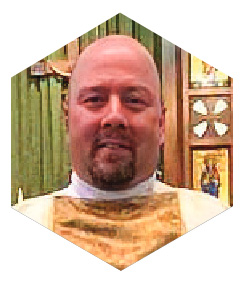 About a week before I preach, I read the readings and let them kind of percolate in my head for a while and pray daily for the Spirit to guide me in writing my homily. Then the day before, I sit down, say a prayer, and let the Spirit guide me.”
— Deacon Todd Summers A week before I preach, I read the readings for the day and reflect on them during the week. I refer to a Scripture commentary. Scripture commentary provides an explanation of the deeper meaning of the original language of Scripture. I learn the social practices and customs that were in place at the time the Scriptures were written. This helps me understand why Jesus would choose the images for his parables. I try to choose current images that convey the same lesson. I try to relate my own life experiences that are similar to the experiences of the characters in the readings.”
— Deacon Jerome Peterson “I read the sacred Scripture for the day I am preparing my homily. I then pray on it, and when I begin to write my initial draft it may change many times over as the Lord's message comes to me in prayer. I find myself tweaking my homilies right up to a few minutes before Mass.”
— Deacon Martin Aubel
PREACHING WITH PEOPLE
The Word is proclaimed to a particular community, so knowing that community matters. Conversations, shared experiences and awareness of local and world events help clergy connect the Gospel with the joys and struggles of the faithful. I base my message on Franciscan values; simplicity, joy, encouragement, humor, everyday life, and most especially, love.”
— Deacon Timothy Good “For Father Luke [Daghir] and me, our parents, Joe and Roben Daghir, continue to shape our preaching. They teach us to be concise and gentle: ‘Honey attracts more flies than vinegar’ is a phrase that our mother has shared with us numerous times. Our parents emphasize preaching with people, not to them, by listening carefully to our parishioners and knowing that we are constantly in need of grace. Our parents also remind us that often the best move a preacher can make is simply to sit down!”
— Father Ben Daghir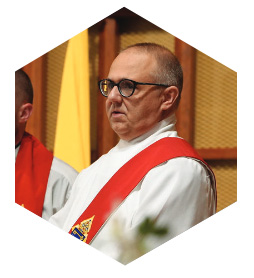 “Another deacon with a style that I like has influenced my preaching style. He gives me suggestions. We discuss each other's homily or ideas for a homily. I think the best advice he has given me is to let the Holy Spirit be in charge. Write the homily out but just before I start to preach, ask the Holy Spirit to tell me what to say.”
— Deacon David Romanowicz
Clergy also carry the voices of teachers, pastors, saints, family members and communicators who have helped form them. Those influences shape not only what they preach, but how they listen, tell stories and leave room for grace.
A MESSAGE CARRIED INTO THE WEEK
Clergy share a hope that the homily will not end when Mass does. They want the faithful to carry the message into prayer, decisions, conversations and encounters throughout the coming week.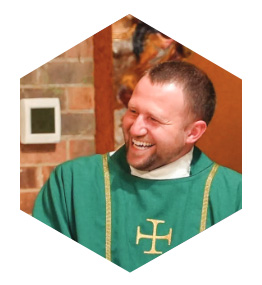 “I was at a preaching conference a few years ago at the Catholic University of America, and one of my favorite preachers and professors, Father Bud Stevens, was on the panel. In answering the question ‘How do you prepare for homilies?’ Father Bud answered, ‘I am always preparing homilies and I am never preparing homilies all at the same time.’ Father Bud then went on to share how the preacher mindset is always looking for homily material through prayer, conversations with others, reading Scripture, watching the news, reading books, reflecting while driving in the car, listening to podcasts, teaching at the school, going to a baseball game, and returning home to visit grandparents, etc. Yet at the same time, the preacher mindset is able to let go and ‘not (overly) prepare/ search for homily material’ so as to let the Holy Spirit move through the week.”
— Father Luke Daghir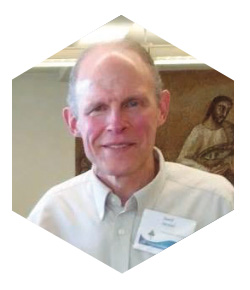 “Since Jesus came to comfort the afflicted and afflict the comfortable, my hope is that the people leave Mass uncomfortable enough from the homily to take the Gospel to prayer, seeking to understand what God is asking of them.”
— Deacon David Jacquel
That trust lies at the heart of the homily. The preacher studies, listens, writes and rehearses, but ultimately offers himself as an instrument through which God’s Word can reach his people – helping the faithful hear what they need and live it in the week ahead.
-