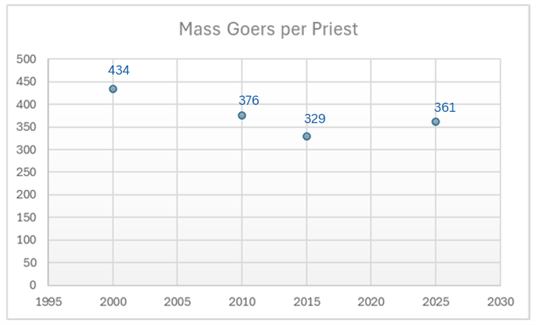
Across the Diocese of Erie, the relationship between the number of priests serving in ministry and the number of Catholics gathering for Sunday Mass has shifted over the past two decades, but remains closely aligned. In 2000, the diocese was served by 186 priests, including diocesan clergy and extern priests, with more than 80,000 Catholics participating in Sunday Mass. By 2025, the number of priests actively serving has declined to 79, while Sunday Mass participation has also decreased to 28,490.
This parallel change reflects broader trends impacting Catholic dioceses nationwide, including priest retirements, fewer ordinations and changing patterns of participation. Seminary enrollment has also shifted during this same period. In 2000, 25 seminarians were in formation for the Diocese of Erie. Today, 7 men are currently discerning and preparing for priestly ministry, continuing the important work of vocational discernment that will shape the future of the Church in northwest Pennsylvania.
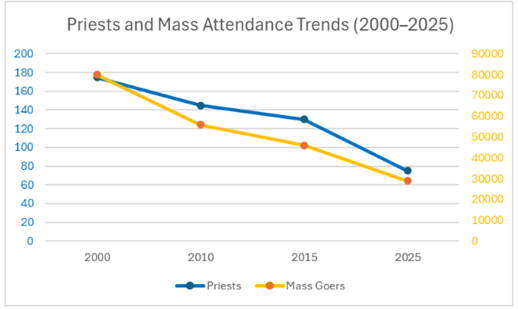
Taken together, these trends show that while both the number of priests and Mass participation have declined, the relationship between them has remained steady. In practical terms, priests today are serving communities of a similar relative size as in previous decades, even as the overall numbers have changed. This consistency underscores the ongoing commitment to providing pastoral care, celebrating the sacraments and accompanying the faithful across the diocese, even as the realities of ministry continue to evolve.
The most recent diocesan vocation and ministry data reflects a pattern that is consistent both locally and nationally — a gradual decline in active clergy and religious, accompanied by smaller seminary cohorts and a modest but steady presence of permanent deacons. Active diocesan priests decreased from 93 in 2024 to 87 in 2025 and 77 in 2026, while the number of women religious declined from 179 to 159 over the same period.
Retired priests increased slightly, signaling the continued aging of the presbyterate. Seminarian totals remain small but stable, with minor movement between formation stages. In contrast, permanent deacons show only a slight decrease, continuing to provide important ministerial support.
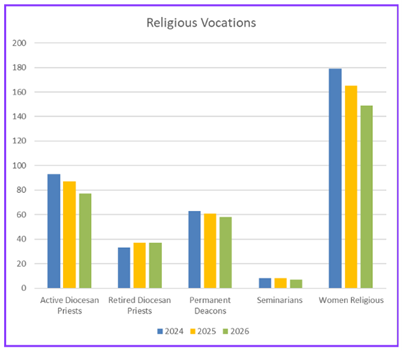
These trends mirror national realities: fewer ordinations, an aging priest population, and fewer women entering religious life — balanced by the growing reliance on collaborative ministry models and lay leadership to sustain parish life and sacramental care.
Clergy projections indicate a continued decline in the number of active priests serving the Diocese of Erie over the next decade. In 2025, the diocese has 79 priests in active ministry. By 2035, that number is projected to decline to 42 — a reduction of nearly half the current workforce.
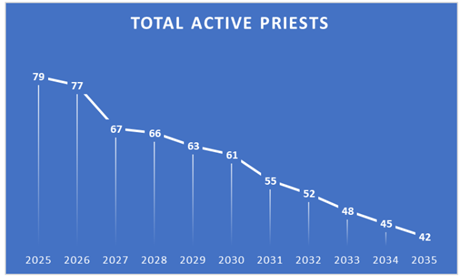
Retirements account for the largest impact, with ordinations occurring at a lower rate and unable to offset annual losses. In some cases, retirements are being deferred, which has helped to temporarily stabilize numbers, but these delays are expected to result in more pronounced declines in the years ahead. The most significant single-year decrease is projected between 2026 and 2027, with a loss of 10 priests. This projection reflects several priests who are generously continuing in ministry beyond age 75 through one-year assignment extensions. While their retirements may not occur all at once, the projection accounts for the possibility of these transitions within that period. In the years that follow, decreases of three to four priests annually are anticipated.
These trends directly affect parish life, increasing the ratio of priests to Masses, sacraments and pastoral responsibilities.
In response, the Diocese of Erie is proactively engaged in pastoral planning — evaluating parish structures, strengthening collaborative ministry models, promoting vocations and welcoming missionary priests to support sacramental life.
Together, these efforts aim to ensure sustainable pastoral care while continuing the church’s mission across the region.