This comparison illustrates how the diocesan footprint has evolved through pastoral planning and parish restructuring.
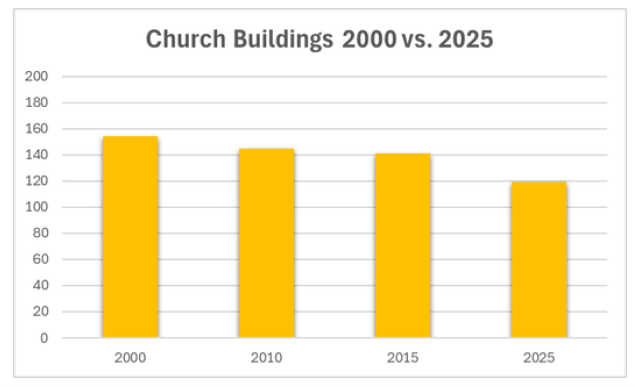
Since Bishop Persico arrived in 2012, the total number of church buildings has declined — driven primarily by a reduction in parish churches. At the same time, mission and secondary worship sites now represent a larger share of active locations. This shift reflects a move away from maintaining multiple full parish structures toward a more collaborative model of ministry — preserving access to worship while more responsibly stewarding buildings that require ongoing care, upkeep and investment, alongside clergy availability and parish populations.
In short, while the number of parish-designated churches has decreased, the Church’s sacramental presence across the diocese remains broad through mission and secondary sites that continue to serve local communities.
One of the most significant insights revealed through the October Count is the relationship between church seating capacity and the number of Catholics attending Mass each weekend.
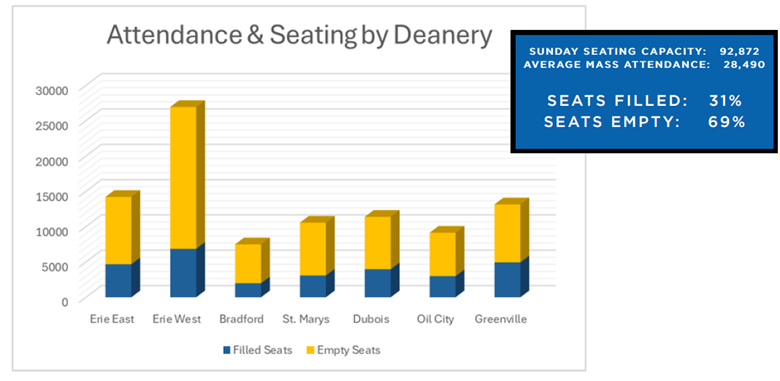
Across the Diocese of Erie, parish churches collectively provide more than 92,000 available seats for Sunday Mass. Yet the most recent October Count recorded 28,490 Catholics attending Mass on an average weekend.
This means that less than one-third of available seating across the diocese is currently filled, while a substantial portion of church space remains unused during weekend liturgies.
When viewed by deanery, a similar pattern appears. For example:
• Erie West Deanery has seating for nearly 27,000 people, while approximately 6,800 attend Mass each weekend.
• Erie East Deanery offers more than 14,000 seats, with roughly 4,600 people attending.
• Greenville Deanery has seating capacity for over 13,000, with about 4,900 attending weekly.
• St. Marys, DuBois, Oil City and Bradford deaneries reflect comparable patterns, with large numbers of available seats alongside smaller but faithful congregations.
This data illustrates an important reality: the Diocese of Erie continues to maintain significantly more physical worship space than is currently being utilized on a typical weekend.
These numbers do not diminish the importance of the faithful who gather each week. Rather, they provide an honest picture of the environment in which parish leaders and diocesan leadership are working to steward resources responsibly.
In response, the diocese has been carefully evaluating parish structures, Mass schedules and building usage to ensure that sacramental life remains strong while resources are used sustainably. In some areas this has meant adjusting Mass times, strengthening collaboration between neighboring parishes or consolidating parish communities.
The goal of these efforts is not simply efficiency, but the long-term vitality of parish life — ensuring that vibrant Catholic communities can continue to gather around the Eucharist across all 13 counties of northwest Pennsylvania. Seen through this lens, the October Count provides more than statistics. It offers a pastoral snapshot of how the Church is living its mission today while planning responsibly for the future.